

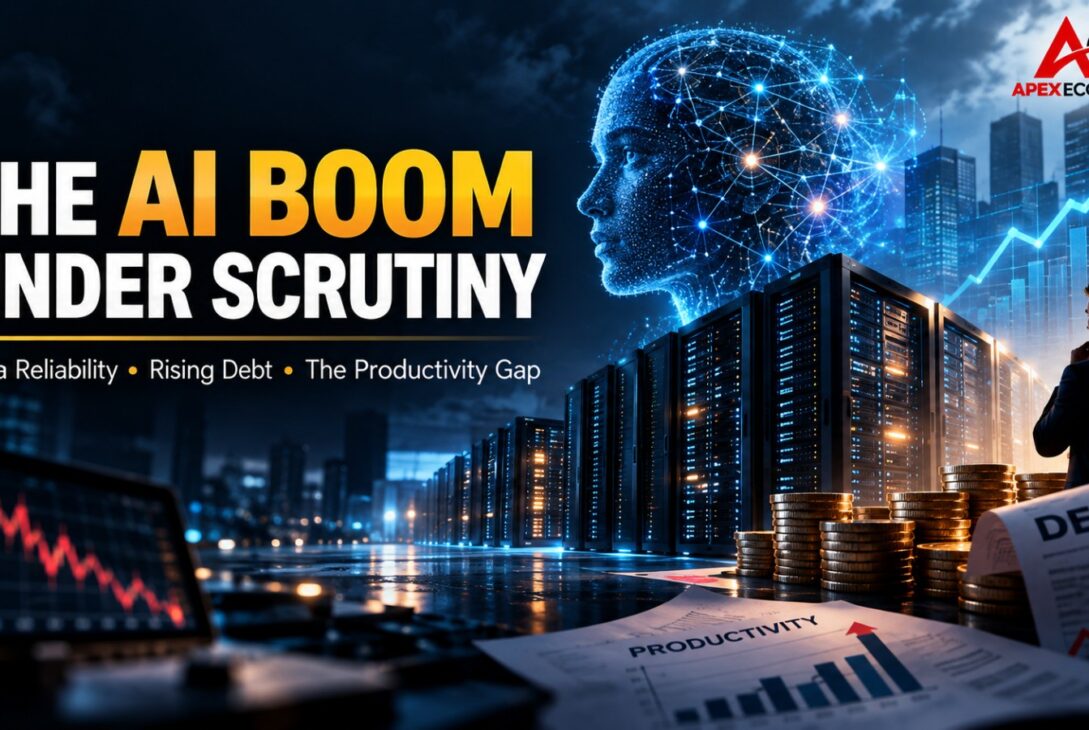
Artificial intelligence (AI) has become one of the biggest drivers of investment, innovation, and financial market expectations. From advanced language models and automated business operations to autonomous systems and AI-powered analytics, companies are investing heavily in the technology to gain a competitive advantage. However, beneath this rapid expansion, economists and market analysts are raising important questions: Are the numbers used to measure AI's success reliable? Can businesses sustain the growing cost of AI infrastructure? And are these massive investments delivering productivity gains that justify their price?
These questions are becoming increasingly important as the industry moves from experimentation to large-scale deployment. According to J.P. Morgan Global Research, global AI capital expenditure could approach $900 billion in 2026, reflecting the enormous financial commitment behind the technology. Yet, spending alone cannot establish whether the investment will generate sustainable economic value.
The Scale of the AI Investment Boom
The AI industry is experiencing a significant infrastructure expansion. Technology companies are investing in data centres, high-performance computing chips, cloud infrastructure, networking equipment, and electricity capacity to support increasingly demanding AI systems.
This investment is not limited to companies developing AI models. Cloud providers, semiconductor manufacturers, energy companies, and infrastructure operators are also benefiting from growing demand.
The International Energy Agency has highlighted the scale of this expansion, reporting that major technology companies' capital expenditure exceeded $400 billion in 2025, with further substantial growth expected in 2026.
These investments could support long-term innovation and economic growth. However, they also create a major financial challenge: companies must generate enough revenue and productivity improvements to justify the cost of building and maintaining this infrastructure.
The central issue is not whether AI technology has value. It is whether the economic benefits will be large enough, arrive quickly enough, and be distributed widely enough to support current investment expectations.
Data Reliability: The Hidden Challenge Behind AI Growth
Reliable data is essential for evaluating any rapidly expanding industry. In the AI economy, however, measuring progress is complicated by differences in how companies report spending, adoption, revenue, and productivity.
For example, a company's total capital expenditure may include conventional cloud infrastructure, software systems, and other technology investments alongside AI-specific projects. Treating the entire amount as AI investment can therefore produce an incomplete or misleading picture.
The Federal Reserve's July 2026 analysis of the AI buildout identifies this measurement challenge, noting that major technology companies' capital expenditure is a useful indicator of infrastructure investment but does not exclusively represent AI spending.
Another challenge concerns adoption metrics. The number of employees using an AI tool does not necessarily reveal how frequently they use it, whether it improves their work, or whether it generates measurable financial benefits.
Similarly, rising AI-related revenue does not automatically demonstrate higher productivity across the broader economy.
A more reliable assessment requires several indicators to be examined together:
-
Investment quality: How much spending directly supports AI infrastructure and deployment?
-
Revenue generation: Are AI products creating sustainable, recurring income?
-
Operational efficiency: Are businesses completing tasks faster or at lower cost?
-
Productivity growth: Is output increasing relative to the labour and capital used?
-
Financial sustainability: Can companies fund operations and repay obligations without relying indefinitely on fresh financing?
Without consistent measurement, investors risk confusing technological activity with proven economic performance.
Rising Debt and the Cost of AI Infrastructure
Building AI infrastructure requires substantial upfront capital. Data centres need specialised chips, cooling systems, reliable electricity, networking equipment, and suitable physical locations. These facilities also require ongoing maintenance and periodic hardware upgrades.
Initially, many large technology companies funded expansion using strong operating cash flows. However, the scale of planned investment is increasing the importance of external financing, including corporate bonds, private credit, and other funding arrangements.
A January 2026 bulletin from the Bank for International Settlements examined this shift from internal cash flows towards debt financing. Its analysis highlighted that the sustainability of the investment cycle depends on AI companies meeting demanding earnings expectations.
Debt is not inherently problematic. Borrowing can be economically productive when investments generate sufficient returns over time. The concern arises when repayment commitments grow faster than the revenue produced by the underlying assets.
If AI adoption expands more slowly than expected, infrastructure providers could face underused capacity, weaker pricing power, or lower returns on investment. Companies with significant borrowing obligations may then have less flexibility to manage costs or invest in new opportunities.
This creates a potential imbalance between the speed of infrastructure construction and the pace at which customers are willing to pay for AI services.
The Productivity Gap: Is AI Delivering Measurable Results?
One of the most important questions surrounding the AI boom is whether its productivity benefits justify its enormous cost.
AI can already help businesses automate repetitive tasks, summarise documents, assist software development, improve customer support, and analyse large datasets. In suitable workflows, these capabilities can reduce the time required to complete specific tasks.
However, improvements at the individual-task level do not automatically translate into economy-wide productivity growth.
Businesses must integrate AI into existing systems, train employees, verify outputs, protect sensitive information, and redesign workflows. These activities require time and money. In some cases, the cost of implementation and human oversight can reduce the savings initially expected.
The 2026 Stanford AI Index also highlights an important distinction: productivity gains are measurable in certain tasks, but evidence of broader productivity improvements remains early and mixed.
This distinction matters because financial markets often value companies based on expectations of future growth. If those expectations assume exceptionally large productivity gains, even meaningful improvements may not be sufficient to justify the original investment.
For businesses, the more practical question is whether AI produces measurable improvements in revenue, operating margins, service quality, or employee output.
Market Expectations and the Risk of Overinvestment
Financial markets respond not only to current earnings but also to expectations about future profitability. When investors anticipate rapid AI-driven growth, company valuations can reflect benefits that have not yet materialised.
This does not mean that the industry is necessarily experiencing a bubble. AI may become a foundational technology with significant long-term economic benefits. Nevertheless, the possibility of overinvestment deserves attention.
A company may build infrastructure based on forecasts of future demand, while customers may delay adoption because of cost, technical limitations, or uncertain returns. If several businesses make similar assumptions simultaneously, the industry could eventually develop excess capacity.
There are historical parallels with earlier technology investment cycles. The expansion of internet infrastructure created enormous opportunities, but some projects failed because expected demand and commercial returns did not arrive as quickly as anticipated.
The lesson is not that AI will follow the same path. Rather, infrastructure spending should be evaluated against realistic demand, financing costs, utilisation rates, and the ability to generate sustainable cash flows.
Investors should distinguish between companies that are successfully commercialising AI and those whose business models depend heavily on optimistic future assumptions.
What Would Make AI Investment More Sustainable?
A sustainable AI economy requires more than technological breakthroughs. It depends on reliable data, disciplined capital allocation, effective implementation, and demonstrable customer value.
Companies should measure AI performance using clear baseline comparisons. For example, they can compare the cost and time required to complete a business process before and after AI implementation, while accounting for software costs, employee oversight, and error correction.
Investors should examine revenue quality, cash flow, debt obligations, and infrastructure utilisation rather than relying exclusively on announcements about spending or model capabilities.
Policymakers and economic researchers also need improved methods for distinguishing AI-related investment from broader technology expenditure and assessing how these investments affect productivity, employment, and economic growth.
Most importantly, organisations should treat AI as a business investment rather than a goal in itself. The objective should be to solve identifiable problems, improve operations, and generate measurable returns.
Conclusion
The artificial intelligence boom represents a major technological and economic opportunity, but its long-term success will depend on whether financial expectations align with measurable results.
Unreliable metrics can distort perceptions of progress, rising debt can increase financial vulnerability, and uncertain productivity gains can challenge the assumptions behind infrastructure spending.
At the same time, dismissing AI's potential would overlook its demonstrated usefulness in numerous tasks and its capacity to transform business operations over time.
The real test is whether the industry can convert technological capability and enormous capital commitments into sustainable revenue, improved productivity, and lasting economic value.
Ultimately, the future of AI will not be determined by how much money companies spend or how quickly infrastructure expands. It will be determined by the quality of the results they deliver.
For investors, businesses, and policymakers, the priority should therefore be clear: look beyond the headlines, question the metrics, examine the underlying economics, and measure AI by its actual contribution to productivity and growth.
Frequently Asked Questions (FAQs)
Q1. Why is the AI investment boom raising concerns?
The rapid growth of AI investment raises concerns about high infrastructure costs, rising debt, uncertain returns, and whether productivity gains justify the spending.
Q2. What is data reliability in the AI industry?
Data reliability refers to the accuracy and consistency of information used to measure AI adoption, revenue, investment, and productivity improvements.
Q3. How does rising debt affect AI companies?
Rising debt increases repayment obligations and financial risk, particularly when AI revenue and returns on infrastructure investments fall short of expectations.
Q4. Is AI investment improving business productivity?
AI can automate tasks and improve efficiency, but actual productivity gains depend on implementation costs, workflow integration, output quality, and measurable business results.
Q5. Could the AI boom lead to a market bubble?
A market bubble is possible if company valuations and infrastructure spending significantly exceed sustainable demand and future earnings. However, this risk does not mean the entire AI industry is